
Will AI Replace Accountants? Why Human Expertise Still Matters in the Age of Automation
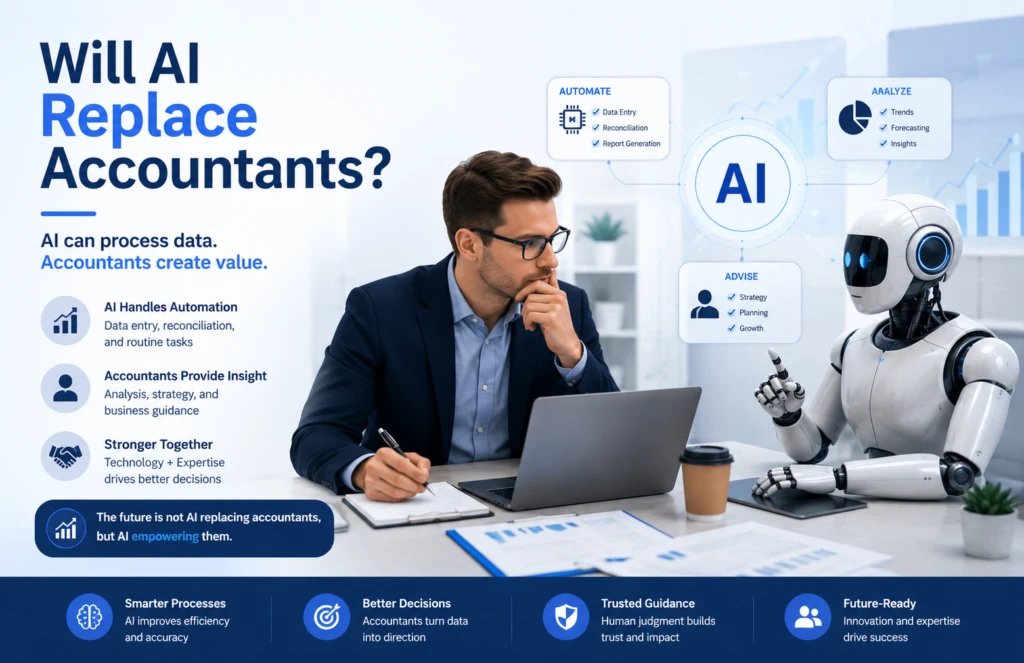
Latest Update (July 2026)
Artificial intelligence continues to evolve rapidly, with accounting software adding more automation, predictive insights, and workflow capabilities. While these advancements are changing how accounting work gets done, they are also increasing the need for professionals who can interpret data, exercise judgment, and ensure compliance with changing financial regulations.
Quick Answer
No, AI will not replace accountants. AI already automates repetitive, rules-based work — transaction categorization, bank reconciliations, invoice processing, and first-pass financial reporting. What it cannot do is exercise professional judgment, interpret ambiguous transactions in business context, apply evolving tax and regulatory rules, or take on the legal accountability a licensed CPA carries. The U.S. Bureau of Labor Statistics projects a 6% decline in clerk-level bookkeeping roles through 2034, but a 5% increase in employment for accountants and auditors over the same period — faster than the average for all occupations, with about 124,200 openings expected every year. The profession is being reshaped by AI, not eliminated by it: routine processing is automating while advisory, compliance, and analytical work grows more valuable.
Key Facts at a Glance
Topic
Summary
AI's biggest strength
Automating repetitive and data-heavy tasks
Human advantage
Judgment, ethics, compliance, communication, and strategy
Most affected work
Data entry, reconciliations, invoice processing, document extraction
Growing opportunities
Advisory services, forecasting, analytics, and financial planning
Future outlook
Human expertise supported—not replaced—by AI
Quick Read
- AI automates repetitive accounting processes.
- Human judgment remains essential for financial decisions.
- Compliance and tax regulations still require professional oversight.
- Advisory services are becoming more valuable.
- Successful accountants will combine technical knowledge with technology skills.
Introduction
Many business leaders are asking: will AI replace accountants? It's a fair question, given how quickly automation has moved into bookkeeping, financial reporting, tax preparation, and audit support.
The reality is more balanced than the headlines suggest. Accounting has always evolved alongside technology. From paper ledgers to spreadsheets to cloud platforms, every major shift has changed daily workflows without eliminating the profession itself. AI is another major shift — one that changes responsibilities more than it replaces people.
Artificial intelligence continues to evolve rapidly, with accounting software adding more automation, predictive insights, and workflow capabilities. While these advancements are changing how accounting work gets done, they are also increasing the need for professionals who can interpret data, exercise judgment, and ensure compliance with changing financial regulations.
What AI Does Best
AI thrives at processing foundational, day-to-day administrative work, which streamlines workflows and shortens reporting timelines.
Modern accounting software already uses AI to:
- Categorize expenses automatically based on historical patterns
- Process invoices using OCR to extract data from receipts and bills
- Match bank transactions and flag duplicate or unusual entries
- Generate financial summaries,/b> and first-pass reports
- Assist with forecasting by identifying trends in historical data
The adoption of AI in accounting has accelerated because finance teams handle enormous volumes of structured data every day. A 2026 Blue J and CPA.com survey of more than 1,000 tax professionals found that 60% now use AI for tax research at least weekly — nearly double the 33% reported just a year earlier. Adoption isn't limited to large firms either: smaller firms (1–10 employees) actually lead adoption at 68%, typically starting with tools like QuickBooks' AI features before expanding into more advanced workflows.
During month-end close, AI can automatically identify missing documentation, suggest reconciliations, and reduce manual review time — helping finance teams complete reporting cycles faster while cutting clerical effort. But automation performs best when financial records follow consistent rules. Once exceptions arise, human expertise becomes far more valuable.
The scale of this shift shows up clearly in labor projections: the U.S. Bureau of Labor Statistics projects employment for bookkeeping, accounting, and auditing clerks — the roles most exposed to routine automation — to decline 6% between 2024 and 2034. That's the segment of the profession AI is absorbing fastest, and it's a very different story from the outlook for licensed accountants and CPAs, covered below.
What AI Can Already Do Well
AI can analyze historical financial data to identify spending patterns, forecast revenue trends, or flag unusual fluctuations that deserve further investigation. Many activities that once required hours of manual effort can now be completed within minutes. That efficiency is exactly why discussions around "accounting replaced by AI" have become so common — but efficiency alone doesn't equal complete financial understanding.
The scale of this shift shows up clearly in labor projections: the U.S. Bureau of Labor Statistics projects employment for bookkeeping, accounting, and auditing clerks — the roles most exposed to routine automation — to decline 6% between 2024 and 2034. That's the segment of the profession AI is absorbing fastest, and it's a very different story from the outlook for licensed accountants and CPAs, covered below.
What AI Cannot Replace
Financial decisions rarely depend on numbers alone. Every business faces unique situations involving changing tax laws, new regulations, unusual transactions, mergers, acquisitions, revenue recognition questions, or operational risk. These scenarios require professional judgment rather than an automated recommendation.
Three things AI structurally cannot do:
- Legal and ethical responsibility. AI cannot sign off on financial statements, sit for audits, or legally carry professional liability.
- Professional judgment. Deciphering ambiguous tax positions or unusual transactions requires weighing intent, business context, and legal interpretation — not just pattern-matching.
- Client relationships. Clients rely on human accountants to understand their business deeply, explain why something happened, and provide strategic advice — not just report what happened.
Consider an unexpected decline in gross margin. AI may identify the variance, but determining whether it resulted from pricing decisions, supplier issues, inventory adjustments, or an accounting treatment choice requires investigation and business knowledge. That distinction answers much of the debate around whether accounting will be replaced by AI: technology identifies patterns, but experienced professionals determine what those patterns actually mean.
Will CPAs Specifically Be Replaced by AI?
For licensed professionals, the answer is still no — and the reasons are structural, not just practical. CPAs carry legal, regulatory, and ethical responsibilities that software cannot assume. Licensure requires ongoing ethics obligations, state-level accountability, and — for many CPAs — the authority to represent clients directly before tax authorities on audits, appeals, and disputes. AI can assist with research, draft analysis, or surface insights from financial data, but the responsibility for accuracy, and for advice given to a client, still rests with the licensed professional signing off on it. As a CPA myself, I can say plainly: the tools have changed what my day looks like, but they haven't changed who's accountable when a client is sitting across from the IRS.
AI-Only Tools vs. AI + CPA: What Each Actually Handles
Task
AI-only tools
AI + CPA (Stratax model)
Transaction categorization
✅ Fully automated
✅ Automated, reviewed for exceptions
Bank reconciliations
✅ Fully automated
✅ Automated, exceptions investigated
Invoice/receipt processing (OCR)
✅ Fully automated
✅ Automated, flagged items verified
Draft financial reporting
✅ Generates first-pass reports
✅ Generated, then reviewed and finalized
Tax position interpretation
❌ Cannot apply judgment to ambiguous cases
✅ CPA judgment applied
Audit representation before IRS/state authorities
❌ Not licensed to represent clients
✅ CPA can represent client directly
Sign-off on financial statements
❌ No legal authority
✅ Licensed CPA accountability
Regulatory/compliance updates
⚠️ Requires manual verification
✅ Monitored and applied by licensed staff
Which Accounting Roles Will Change the Most?
Not every accounting responsibility will evolve at the same pace. Clerk-level roles are projected to shrink, but the outlook for credentialed accountants points the opposite direction: the BLS projects 5% employment growth for accountants and auditors from 2024 to 2034 — faster than the average for all occupations — with about 124,200 openings expected every year, driven largely by retirements, economic growth, and increasingly complex tax and regulatory requirements.
Entry-level work involving repetitive processing is becoming increasingly automated. Data entry, invoice coding, transaction matching, and document organization already require less manual effort than they did a few years ago. Meanwhile, responsibilities involving analysis, planning, compliance, and client communication are becoming more valuable. Finance and accounting professionals are increasingly expected to:
- Interpret Financial Results Management relies on accountants to explain performance rather than simply prepare reports.
- Support Strategic Planning Budgets, forecasts, investment analysis, and profitability reviews require business insight that AI cannot independently provide.
- Maintain Regulatory ComplianceTax authorities and financial reporting standards continue to evolve. Human oversight remains essential for interpreting new rules correctly.
- Strengthen Internal Controls Companies still need professionals to review processes, investigate unusual transactions, and reduce fraud risk.
Skills Accountants Need for the Future
Instead of competing against AI, accountants benefit from learning how to work alongside it. There's a real readiness gap worth naming here: an AICPA and CIMA global survey of 1,446 senior finance leaders found that 88% believe AI will be the most transformative technology trend in accounting over the next 12–24 months, yet only 8% feel their organization is very well prepared to manage it. That gap is exactly where accountants who build AI fluency now can differentiate themselves.
Risks of Depending Too Much on AI
AI offers significant efficiency gains, but relying on it without proper oversight creates risks. AI models can misunderstand incomplete documentation, misclassify unusual transactions, or generate inaccurate recommendations if underlying data contains errors.
Businesses also remain responsible for:
- Financial statement accuracy
- Tax compliance
- Regulatory reporting
- Internal controls
- Audit readiness
These responsibilities cannot simply be delegated to software. Organizations should treat AI as a productivity tool rather than an independent decision-maker. Regular review, documentation, and professional oversight remain essential components of sound financial management.
The Future of Accounting Is Human + AI
The profession is shifting toward collaboration between technology and people. Routine work will keep becoming more automated, freeing accountants to focus on advisory services, business strategy, financial planning, risk management, and decision support. So, will AI replace accountants? The evidence increasingly suggests AI will redefine accounting careers rather than eliminate them. Professionals who embrace technology while continuing to develop judgment, communication, and analytical skills are positioned for more opportunity, not less.
How Stratax Advisors Helps
Looking to modernize your accounting processes without sacrificing accuracy or compliance? Stratax Advisors combines modern automation with hands-on CPA oversight — monthly bookkeeping, quarterly tax planning, and annual filing handled by one team.
Service
Typical Monthly Cost
What's Included
Bookkeeping only
$300–$1,500/mo
Transaction recording, reconciliation, basic reporting
Tax prep only (annual, LLC/S-Corp)
$750–$2,500/yr (roughly $60–$210/mo averaged)
Return preparation and filing, single entity
Bundled bookkeeping + tax (Stratax)
$300-1250/mo
Monthly bookkeeping, quarterly tax planning, and annual filing — one CPA-led team
Conclusion
Artificial intelligence is reshaping accounting, but it is not replacing the profession. It's changing where accountants create the greatest value. Routine processing is becoming faster and more efficient, while advisory work, regulatory interpretation, financial analysis, and strategic planning continue to depend on experienced professionals. The future belongs to organizations that combine intelligent automation with knowledgeable accountants who can turn financial information into confident business decisions.
Frequently Asked Questions :
I can assist in compiling financial information and generating draft reports, but it cannot independently verify accuracy, interpret complex transactions, or ensure compliance with accounting standards. Human review remains essential before financial statements are finalized and shared with management, investors, or regulators.
Routine activities such as invoice processing, bank reconciliations, transaction categorization, receipt extraction, and document management are increasingly automated. Accountants still review exceptions, investigate discrepancies, and validate the accuracy of financial records before reporting.
Current trends suggest the profession is evolving rather than disappearing. Demand continues to grow for professionals who can provide financial analysis, regulatory guidance, business advice, and strategic planning, even as repetitive work becomes more automated.
By developing stronger analytical, communication, advisory, and technology skills. Professionals who understand both accounting principles and modern automation tools are best positioned to deliver business value and make good use of AI-assisted workflows.
No. Compliance depends on accurate interpretation of tax laws, accounting standards, documentation requirements, and regulatory updates. Automation improves efficiency, but businesses remain accountable for financial reporting, making professional oversight essential to avoid costly errors.
No. CPAs carry legal, ethical, and regulatory responsibilities — including representing clients before tax authorities — that software cannot take on. AI can support research and analysis, but a licensed CPA remains accountable for the final work product.
There's no evidence of a replacement timeline. BLS projections through 2034 show clerk-level bookkeeping roles declining 6% as routine tasks automate, while licensed accountant and auditor roles grow 5% over the same period. The shift is a redistribution of work, not a phase-out of the profession.
What’s Next?
Looking to modernize your accounting processes without sacrificing financial accuracy or compliance? Stratax Advisors helps businesses strengthen reporting, improve operational efficiency, and maintain dependable financial controls while adapting to today's evolving accounting technologies. Contact our team to learn how practical accounting expertise and modern tools can work together to support smarter business decisions.
About the Author

Bruno serves as Managing Partner of Stratax Advisors, bringing extensive leadership experience across public accounting, corporate finance, and private equity–backed enterprises. He holds a B.S. in Accounting from Villanova University and began his career in public accounting as an auditor with a large international firm. A Certified Public Accountant (CPA) licensed in Pennsylvania, Bruno has led corporate financial reporting for Fortune 500 companies, including Comcast, and has held Controller, CFO, and COO roles for private companies backed by private equity. His expertise spans mergers and acquisitions, corporate financing, ERP implementations with Microsoft Dynamics and SAP, and fractional CFO services. Bruno is SAP certified and brings hands-on experience with QuickBooks, along with deep knowledge of corporate and individual taxation, enabling him to deliver strategic, technology-driven financial leadership to clients.
Let’s Take Our Conversation Ahead
At Stratax, we empower individuals and businesses to make confident financial decisions. With deep expertise and unwavering precision, we deliver solutions that safeguard your future and accelerate your success.
Schedule a Meeting