
What Is Cost Segregation? Benefits & 2026 Tax Savings Guide
Latest Update (July 2026)
Commercial real estate owners continue to look for legitimate ways to improve cash flow without increasing operational risk. Cost segregation remains one of the most effective tax planning tools available because it allows qualifying assets to be depreciated over shorter recovery periods while remaining compliant with IRS guidelines when properly documented.
Quick Answer
On a typical commercial property, a cost segregation study reclassifies roughly 20–40% of the depreciable basis into shorter-life categories, according to industry benchmarks from cost segregation providers and CPA firms (the exact share depends on construction type and use — see the property-type breakdown below). Because 100% bonus depreciation applies to qualifying property placed in service after January 19, 2025, that reclassified portion can typically be deducted in full during the first year. On a $1,000,000 commercial property, that can mean tens of thousands of dollars in first-year tax savings. See the worked example below for the full math.
Key Facts at a Glance
Topic
Details
Purpose
Accelerate depreciation deductions on qualifying building components
Eligible Properties
Commercial, industrial, healthcare, hospitality, retail, and multifamily buildings
Primary Advantage
Improved cash flow through earlier tax deductions
Typical Reclassification
20%–40% of a property's total cost, depending on construction type and use [verify this range against your own client data or a sourced industry study before publishing — flagged here as a placeholder, not a number to publish unverified]
Current Bonus Depreciation Rate
100% for qualifying property acquired and placed in service after January 19, 2025, under the OBBBA
Documentation
Engineering-based analysis with detailed cost allocation
Best Time to Perform
After acquisition, construction, or major renovation — though look-back studies are available for existing properties
Depreciable Basis Guideline
Studies typically deliver the strongest ROI on properties with a depreciable basis of $1,000,000 or more [verify against your own engagement data before publishing as a firm claim]
Quick Read
- Accelerates depreciation on qualifying building assets.
- Improves short-term cash flow by increasing early tax deductions.
- Applies to both newly acquired and existing commercial properties.
- Under the OBBBA, qualifying assets placed in service after January 19, 2025 can be fully expensed in year one via 100% bonus depreciation.
- Requires detailed engineering and tax analysis.
- Supports long-term financial planning and tax efficiency.
- Works best when integrated into broader business tax decisions.
Introduction
Owning commercial real estate comes with significant financial responsibilities, but it also creates opportunities to improve tax efficiency. Many property owners focus on operating income, financing, and maintenance while overlooking how depreciation affects overall cash flow. Standard depreciation schedules are appropriate for many situations, yet they may not fully reflect the value of individual building components that qualify for shorter recovery periods.
Understanding cost segregation benefits allows businesses to make better use of existing tax rules rather than paying more tax earlier than necessary. By accelerating depreciation on eligible assets, organizations can preserve working capital, strengthen liquidity, and create additional financial flexibility for future investments. For finance leaders, this is often a practical decision that supports both current operations and long-term planning.
What Is Cost Segregation?
Cost segregation is a tax planning technique that separates qualifying building components from the overall structure so they can be depreciated over shorter recovery periods. Instead of treating every part of a building as a single long-term asset, the analysis identifies items that may qualify for five-, seven-, or fifteen-year depreciation rather than the standard 27.5 or 39 years.
A cost segregation study typically separates a property into three component categories, each with its own recovery period:
Personal Property (5–7 years): Specialty lighting, decorative fixtures, carpeting, and certain appliances.
Land Improvements (15 years): Fencing, sidewalks, landscaping, and parking lots.
Building Structure (27.5 or 39 years): Walls, roofs, and standard plumbing — the components that remain on the standard depreciation schedule.
Cost segregation studies are performed by specialized engineering-and-tax firms — national providers like KBKG and Capstan Tax are two well-known examples — using detailed cost allocation methods rather than rough estimates. Stratax Advisors coordinates this process for clients: we help select and manage the right engineering firm for your property type, review the resulting study for defensibility against IRS scrutiny, and integrate the findings into your broader tax planning strategy — so the deductions actually translate into cash flow decisions, not just a report that sits unused.
A Worked Example: What Cost Segregation Actually Saves
Say you purchase a $1,500,000 office building, with $300,000 allocated to non-depreciable land and $1,200,000 to the building itself.
Without a cost segregation study: The full $1,200,000 depreciates over 39 years — a first-year deduction of roughly $30,770.
With a cost segregation study, an engineering-based analysis identifies:
- $180,000 of interior fixtures and finishes qualifying for 5-year depreciation
- $120,000 of specialized electrical and plumbing components qualifying for 7-year depreciation
- $100,000 of land improvements (parking, landscaping, sidewalks) qualifying for 15-year depreciation
Because these reclassified assets were placed in service after January 19, 2025, they qualify for 100% bonus depreciation under the OBBBA — meaning the full $400,000 can potentially be deducted in year one, rather than depreciated gradually.
Without Cost Segregation
With Cost Segregation + Bonus Depreciation
Year-one deduction
~$30,770
~$400,000 + remaining building depreciation
Depreciation period on reclassified assets
39 years
Immediate (100% bonus)
Total depreciation over property life
Unchanged
Unchanged
Cost Segregation Tax Strategy: How It Fits Your Broader Plan
A cost segregation tax strategy works best when it's treated as one piece of a larger tax plan rather than a standalone deduction. On its own, accelerated depreciation improves cash flow. Combined with Real Estate Professional Status (REPS) or the short-term rental loophole, it can also offset active income like W-2 wages or business profits — not just passive rental gains.
Property owners who build cost segregation into their year-round tax strategy — rather than running it as a one-time study after purchase — tend to get more value from it. That means coordinating the timing of the study with acquisition or renovation dates, evaluating REPS eligibility before year-end, and reviewing how the resulting deductions affect estimated tax payments and financing decisions. Because these pieces interact, most owners work through this alongside a CPA rather than treating the study as an isolated project.
Understanding Cost Segregation Benefits
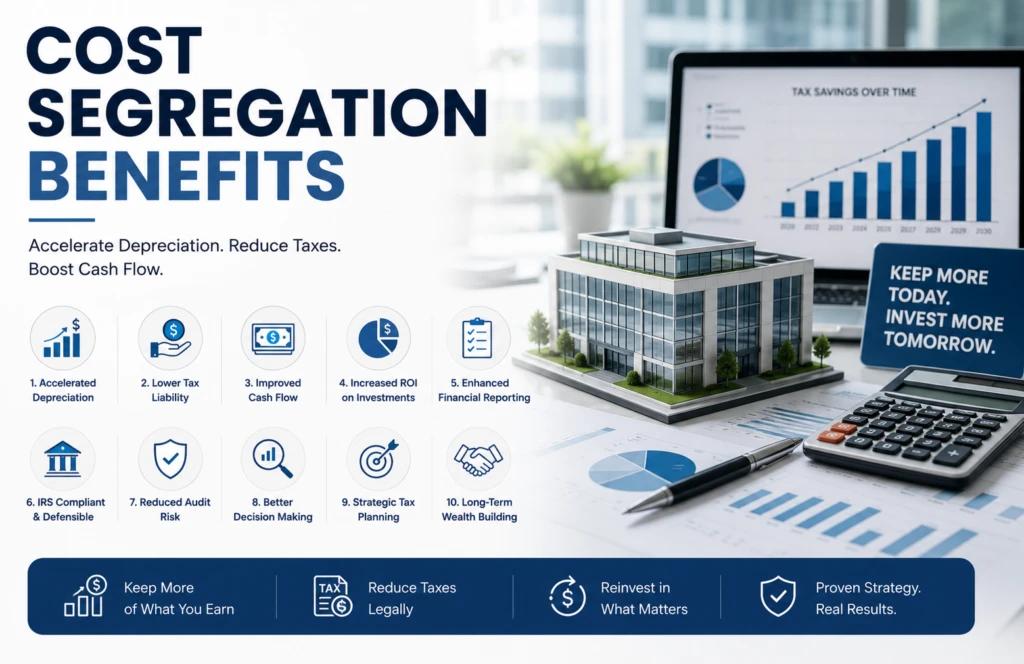
The greatest advantage of cost segregation is improved timing. Earlier depreciation deductions reduce taxable income during the initial years of property ownership, allowing businesses to retain more cash for operational needs.
These Cost Segregation Benefits can influence far more than annual tax returns. Additional liquidity may help fund equipment purchases, technology upgrades, facility improvements, hiring plans, or debt reduction without relying entirely on external financing.
For companies experiencing rapid growth, improved cash flow can reduce financial pressure during periods of significant investment. Organizations that own multiple properties may also benefit from reviewing each asset individually, since depreciation opportunities often vary based on construction type, renovation history, and property use.
Many finance leaders incorporate cost segregation into broader business tax planning strategies because it supports both tax efficiency and long-term capital planning rather than focusing solely on annual tax compliance.
Suppose a business acquires a $2,000,000 office building (excluding land value). Under standard depreciation, that full amount is written off over 39 years — roughly $51,000 per year.
A cost segregation study might reclassify 20–30% of that basis — commonly $400,000–$600,000 — into 5-, 7-, and 15-year property. Because that reclassified portion currently qualifies for 100% bonus depreciation under the One Big Beautiful Bill Act for property placed in service after January 19, 2025, the owner could potentially deduct that full $400,000–$600,000 in year one, instead of spreading it across decades.
These figures are illustrative only. The actual reclassification percentage and resulting deduction depend on the property's construction type, age, and components, and should be confirmed through an engineering-based study.
Cost Segregation Tax Benefits at a Glance
The core cost segregation tax benefits come down to three things: earlier deductions, stronger short-term cash flow, and more flexibility to offset income when paired with REPS or short-term rental status. None of these increase the total depreciation available over the property's life — they shift when you get to claim it, which is what makes the timing advantage valuable.
How 2026's 100% Bonus Depreciation Changes the Math
The OBBBA, signed July 4, 2025, permanently restored 100% bonus depreciation for qualifying property acquired after January 19, 2025 — reversing a scheduled phase-down that would have dropped the rate to 20% in 2026 and 0% in 2027. In practice, this means every asset a cost segregation study reclassifies into a 5-, 7-, or 15-year bucket can now be deducted in full during the first year it's placed in service, rather than depreciated gradually.
For example: a $3 million property where a study identifies 30% ($900,000) as qualifying components can generate a $900,000 first-year deduction under 100% bonus depreciation — instead of that amount trickling out over 5 to 15 years. IRS Notice 2026-11, issued January 14, 2026, provides the interim guidance confirming how this applies, including a "component election" that lets owners claim 100% bonus depreciation on qualifying pieces of a larger project even when the overall build doesn't meet the timing test.
Acquisition date matters more than placed-in-service date here — property tied to a binding contract signed before January 20, 2025 may still fall under the old, lower phase-down rates regardless of when it's placed in service. Because these rules shift with each legislative update, it's worth reviewing current tax regulations with an advisor before assuming a rate applies.
Which Properties Qualify?
Cost segregation applies to a wide range of income-producing properties across the industries we serve, not just large ground-up developments. Common candidates include:
Cost Segregation ROI: Is the Study Worth It on Your Property?
The study fee is fixed; the tax savings scale with property value. Here's a rough break-even guide by depreciable basis, assuming a 25–30% reclassification rate and current federal + state tax rates near 30% combined.
Depreciable Basis
Typical Study Fee
Est. Reclassified (25–30%)
Est. Year-1 Tax Savings*
Savings*Rough ROI
$500,000
$4,000–$6,000
$125,000–$150,000
$35,000–$45,000
6–8x
$1,000,000
$5,000–$8,000
$250,000–$300,000
$70,000–$90,000
10–14x
$2,500,000
$7,000–$12,000
$625,000–$750,000
$175,000–$225,000
18–25x
$5,000,000+
$10,000–$18,000
$1,250,000+
$350,000+
25x+
*Illustrative only — assumes 100% bonus depreciation eligibility under OBBBA and a combined ~30% tax rate. Actual savings depend on entity type, passive activity limitations, and state conformity to bonus depreciation. Confirm with a tax advisor before relying on these figures.
Rule of thumb: below roughly $500,000 in depreciable basis, the study fee starts eating meaningfully into the benefit — still often worthwhile, but worth a feasibility call first. Above $1M, cost segregation is almost always a net positive.
Cost Segregation by Property Type: What Changes
The 20–40% reclassification range hides real variation by property type. A quick comparison:
- Self-storage facilities — high land-improvement ratio (paving, fencing, security systems) often pushes reclassification toward the higher end, commonly 30–40%.
- Medical and dental offices — specialized electrical, plumbing, and equipment-specific buildouts (X-ray rooms, exam room wiring) frequently qualify at above-average rates.
- Short-term rentals — furniture, appliances, and finishes reclassify heavily, and — as covered above — the short-term rental loophole can let owners offset active income with the resulting losses, not just passive rental income.
- Multifamily under $1M — smaller basis means the study fee is a bigger share of the benefit; still frequently worthwhile given how much of a typical apartment building (flooring, appliances, cabinetry) qualifies for 5-year treatment.
- Restaurants — heavy specialty equipment and dedicated electrical/plumbing for kitchens often push reclassification well above the general 20–40% range.
Offsetting Active Income: REPS and the Short-Term Rental Loophole
By default, depreciation losses from rental real estate are "passive" and can only offset passive income — they can't reduce your salary or business income. Two exceptions change that:
Real Estate Professional Status (REPS): If you or your spouse qualify by meeting IRS material participation and hours thresholds, real estate losses — including large first-year bonus depreciation from a cost segregation study — can offset active, non-real-estate income like W-2 wages or business profits.
Short-term rental loophole: Properties with an average guest stay of 7 days or less (and material participation by the owner) are treated as a business rather than passive rental activity, regardless of REPS status. This lets many short-term rental owners use accelerated depreciation to offset active income without qualifying as a real estate professional.
Both paths require careful documentation of hours and material participation — a professional evaluation before filing is worth the cost given the IRS scrutiny these positions receive. Individual investors weighing these strategies should evaluate them alongside their broader individual tax planning.
When Does Cost Segregation Make Financial Sense?
Not every commercial property will generate the same level of tax savings, which is why timing and property characteristics play an important role. In general, cost segregation delivers the greatest value for recently acquired, newly constructed, or substantially renovated commercial properties where qualifying assets can be clearly identified. As a general guideline, studies tend to deliver the strongest return on properties with a depreciable basis of $1,000,000 or more — smaller properties can still benefit, but the study cost should be weighed more carefully against the expected deduction. [Verify this threshold against your own client data before publishing it as firm guidance.]
Businesses that have owned a property for several years should not assume they have missed their opportunity. A look-back study can identify depreciation that was not previously accelerated — and because it's filed as a change in accounting method using IRS Form 3115, owners can claim the full missed deduction as a catch-up adjustment in the current tax year, without amending prior returns. Reviewing properties as part of regular tax planning can help determine whether the expected tax savings justify the cost of the study and support broader financial objectives.
Is Cost Segregation Right for You?
Cost segregation tends to deliver the strongest results when a property and its owner meet a few specific conditions:
You plan to hold the property long-term. The timing benefit compounds — the earlier you accelerate deductions, the more the time value of that cash works in your favor over a multi-year hold.
You have active real estate income to offset — or qualify for REPS. Without Real Estate Professional Status or the short-term rental loophole, accelerated losses can only offset passive income, not W-2 wages or business profits.
You've spent over $1,500,000 on purchasing, constructing, or remodeling a building within the last 15 years. Below this range, the study fee starts eating meaningfully into the benefit, though smaller properties can still be worthwhile — see the ROI table above.
If your situation matches most of these, a feasibility review is generally worth the cost of the study.
Cost Segregation and Bonus Depreciation
Cost segregation and bonus depreciation work together directly: once a study identifies which building components qualify for 5-, 7-, or 15-year recovery periods, those same components become eligible for bonus depreciation.
Under the One Big Beautiful Bill Act (OBBBA), signed into law in July 2025, 100% bonus depreciation is now permanent for qualifying property acquired and placed in service after January 19, 2025 — reversing what had been a scheduled phase-down to 40% in 2025 and 0% by 2027 under the prior law. In practice, this means assets identified through a cost segregation study can often be fully deducted in the year they're placed in service, rather than depreciated gradually — a significant change from the declining bonus percentages property owners were planning around as recently as 2024.
Property acquired under a binding written contract signed before January 20, 2025 generally remains subject to the prior phase-down schedule, so the exact acquisition date matters. Because these rules can be complex and continue to be refined through IRS guidance, businesses should confirm eligibility with a tax advisor before finalizing capital planning decisions.
How the Process Works
What the IRS Actually Flags in a Cost Segregation Audit
Cost segregation itself isn't a red flag — the IRS has published its own Cost Segregation Audit Techniques Guide and treats properly documented studies as routine. What draws scrutiny is how the reclassification was done:
- No engineering basis. Studies built on cost estimates or percentage rules of thumb, rather than actual blueprints, invoices, and site inspection, are the single most common trigger for IRS pushback.
- Aggressive reclassification of structural components. Items functionally part of the building (central HVAC serving the whole structure, load-bearing elements, roofing) get flagged when classified as 5- or 7-year personal property without a defensible functional-use argument.
- Missing documentation trail. The IRS ATG expects a clear paper trail connecting each reclassified cost back to a specific invoice, contract, or blueprint line item — not a lump-sum allocation.
- Reclassification percentage that's an outlier. Reclassifying 50%+ of a building's basis, well outside the typical 20–40% range, invites a closer look unless the property type genuinely supports it (e.g., a restaurant with heavy specialty equipment).
- DIY or software-only studies with no engineer or CPA sign-off. The IRS ATG specifically calls out studies lacking a qualified preparer as lower-reliability.
Most owners fold this process into their broader business tax planning strategy rather than treating it as a one-off project.
Common Mistakes to Avoid
- Assuming every property benefits equally. Savings depend on purchase price, construction type, and the volume of qualifying components.
- Using estimates instead of an engineering-based study. Weak documentation increases audit risk.
- Waiting too long. Deductions delayed are deductions not compounding — evaluate soon after acquisition or renovation.
- Ignoring acquisition-date rules. Under OBBBA, a property acquired via a pre-January 20, 2025 binding contract may not qualify for the 100% rate even if placed in service in 2026.
- Treating it as a standalone project rather than coordinating it with financing, REPS planning, and broader tax strategy.
Potential Limitations to Consider
Engineering-based studies carry a professional fee, typically starting in the low thousands depending on property complexity — this should be weighed against projected tax savings, especially for smaller properties with few qualifying components. Accelerated depreciation also increases the depreciation recapture exposure at sale, since more of the property's basis has already been deducted, and revised schedules should be reflected in financial reporting and audit readiness. A qualified advisor can model both sides before you commit.
How Stratax Advisors Helps
Every commercial property has unique characteristics, and determining whether cost segregation is worthwhile requires careful analysis rather than assumptions. Stratax Advisors helps businesses evaluate their properties, understand potential depreciation opportunities, and integrate those findings into practical tax planning decisions.
Our approach begins with reviewing the property's acquisition details, construction records, renovation history, and available financial documentation. By examining these details alongside your business objectives, we help identify opportunities that improve tax efficiency while maintaining compliance with applicable regulations.
Beyond identifying accelerated depreciation opportunities, Stratax Advisors works with clients to understand how the results affect cash flow forecasting, estimated tax payments, financial reporting, and future investment decisions. The goal is not simply to generate larger deductions but to ensure those deductions contribute to stronger financial planning and operational stability.
Stratax Advisors helps businesses evaluate their properties, understand potential depreciation opportunities, and integrate those findings into practical tax planning decisions.
Conclusion
Commercial real estate is more than a long-term investment—it can also become an important part of an organization's overall tax strategy. By identifying assets that qualify for accelerated depreciation, businesses can improve the timing of deductions, preserve working capital, and strengthen financial flexibility without changing the total depreciation available over the life of the property.
Understanding the benefits of cost segregation allows business owners and finance leaders to make more informed decisions about cash flow, capital investment, and future growth. When supported by accurate analysis and thorough documentation, cost segregation becomes a valuable planning tool that continues to deliver financial advantages well beyond the initial tax year.
Frequently Asked Questions :
Properties used for commercial purposes—including office buildings, warehouses, medical facilities, hotels, retail locations, and apartment communities—often qualify for cost segregation. Factors such as purchase price, construction type, renovation history, and the value of qualifying assets determine the potential savings. A professional evaluation is the best way to assess whether the expected tax benefits justify the study.
Yes. Businesses are not limited to newly acquired properties. Existing buildings may qualify through a look-back study, filed via IRS Form 3115, that identifies depreciation opportunities missed in prior years — without amending past returns.
It can. Accelerated depreciation primarily influences tax reporting, but businesses should also evaluate how revised depreciation schedules affect financial statements and audit readiness, budgeting, and cash flow forecasts.
Cost segregation is a well-established tax planning method when supported by proper engineering analysis and documentation. Risks generally arise when asset classifications are based on estimates or incomplete records. Working with qualified professionals helps ensure that depreciation positions are properly documented and consistent with applicable IRS guidance.
Yes. Investors who own qualifying income-producing properties may also benefit from accelerated depreciation, depending on their specific tax situation. Because every taxpayer's circumstances differ, cost segregation should be evaluated alongside other tax planning strategies for individuals to determine how it supports long-term investment and tax objectives.
Only to qualifying property acquired after January 19, 2025, per the OBBBA. Property under a binding contract signed earlier may remain on the old phase-down schedule (40% in 2025, 20% in 2026) even if placed in service later.
Yes. Individual owners of qualifying income-producing property can benefit, particularly when combined with REPS or the short-term rental loophole to offset active income.
No. It accelerates timing, not the total amount. The full depreciation is still capped at the property's basis — you're taking it sooner, not taking more of it.
Yes — and it's more valuable than it's been in years. Under the OBBBA, 100% bonus depreciation was made permanent for qualifying property acquired and placed in service after January 19, 2025, reversing a scheduled phase-down that would have reduced it to 0% by 2027. This means assets identified through a cost segregation study — items with a 5-, 7-, or 15-year recovery period — can generally be fully deducted in the first year, rather than depreciated gradually.
It's most effective when used as a tax strategy, not a one-time deduction. The accelerated depreciation itself is just a timing benefit — its real value comes from coordinating it with REPS status, short-term rental treatment, or broader capital planning, so the resulting deductions actually offset the income you want them to.
What’s Next?
If your business has recently purchased, constructed, or renovated commercial property, now is an excellent time to evaluate whether cost segregation can improve your tax position — especially alongside sound GAAP accounting principles for accurate reporting.
Stratax Advisors helps businesses assess property eligibility, review depreciation opportunities, and develop practical solutions that align with their financial objectives. Our experienced professionals provide clear guidance, reliable analysis, and the technical support needed to help you make confident tax planning decisions.
About the Author

Bruno serves as Managing Partner of Stratax Advisors, bringing extensive leadership experience across public accounting, corporate finance, and private equity–backed enterprises. He holds a B.S. in Accounting from Villanova University and began his career in public accounting as an auditor with a large international firm. A Certified Public Accountant (CPA) licensed in Pennsylvania, Bruno has led corporate financial reporting for Fortune 500 companies, including Comcast, and has held Controller, CFO, and COO roles for private companies backed by private equity. His expertise spans mergers and acquisitions, corporate financing, ERP implementations with Microsoft Dynamics and SAP, and fractional CFO services. Bruno is SAP certified and brings hands-on experience with QuickBooks, along with deep knowledge of corporate and individual taxation, enabling him to deliver strategic, technology-driven financial leadership to clients.
Let’s Take Our Conversation Ahead
At Stratax, we empower individuals and businesses to make confident financial decisions. With deep expertise and unwavering precision, we deliver solutions that safeguard your future and accelerate your success.
Schedule a Meeting