
Bookkeeping vs. Accounting: Why Growing Businesses Often Need Both
In this guide
As financial operations become more complex in 2026, businesses are paying closer attention to the difference between bookkeeping vs accounting and how both functions impact reporting accuracy, tax compliance, and cash flow management. Growing companies are increasingly integrating bookkeeping and accounting services together to improve financial visibility, forecasting, and long-term operational decision-making.
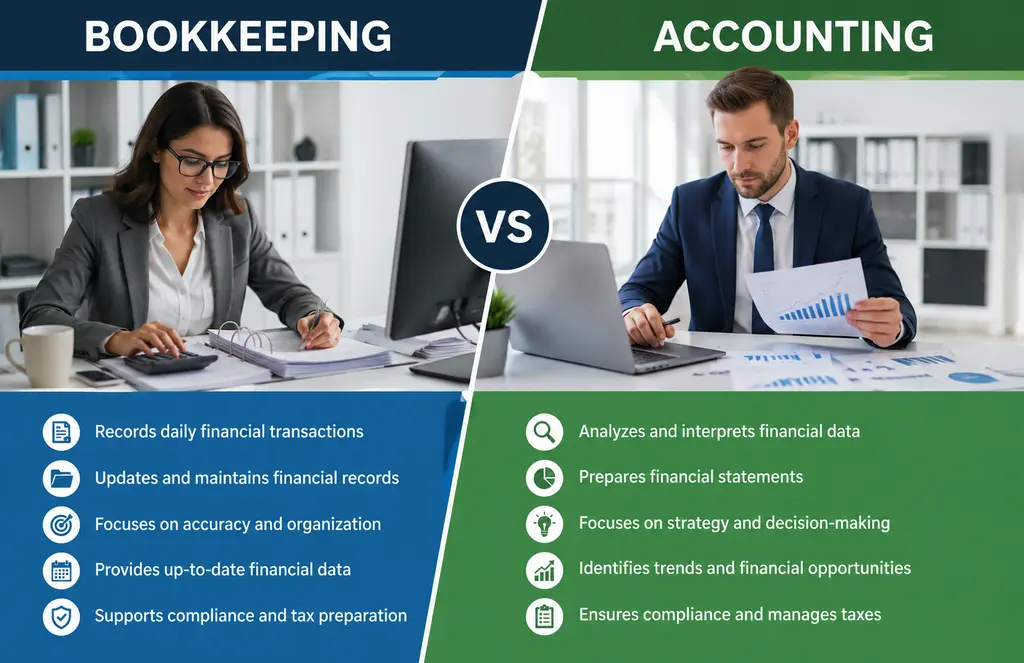
Answer Snippet The difference between bookkeeping vs accounting comes down to recording financial activity versus analyzing and interpreting it. Bookkeeping focuses on maintaining accurate daily transaction records, while accounting turns those records into reports, insights, and compliance-ready financial information. Most growing businesses eventually need both functions working together. Key Facts at a Glance| Function | Bookkeeping | Accounting |
| Primary Role | Records transactions | Analyzes financial data |
| Focus | Daily financial activity | Strategy and reporting |
| Common Tasks | Invoicing, reconciliations, payroll entries | Forecasting, tax planning, financial analysis |
| Timing | Ongoing and transactional | Periodic and analytical |
| Business Impact | Accuracy and organization | Decision-making and compliance |
- bookkeeping vs accounting is not a matter of choosing one over the other
- Bookkeeping keeps financial records organized and current
- Accounting interprets financial data for planning and compliance
- Weak bookkeeping creates reporting and tax issues later
- Growing companies usually need both functions aligned
- Delayed reconciliations often create month-end reporting pressure
- Reliable records improve forecasting and operational visibility
Introduction
Many business owners assume bookkeeping and accounting are interchangeable until financial issues start surfacing. Missed reconciliations, inconsistent reports, delayed tax filings, or unclear cash positions usually expose the gap quickly. What appears to be a “numbers problem” is often a workflow problem between recording transactions and interpreting them properly. The discussion around bookkeeping vs accounting matters because both functions affect daily operations differently. One keeps the financial engine organized. The other helps leadership understand what those numbers actually mean. Without accurate bookkeeping, accounting becomes reactive and time-consuming. Without accounting oversight, businesses may operate for months without understanding profitability trends, cash risks, or compliance exposure. For companies dealing with vendor growth, payroll expansion, seasonal sales fluctuations, or tighter reporting expectations, the distinction becomes operationally important rather than theoretical.What Is the Difference Between Bookkeeping and Accounting?
At a basic level, bookkeeping focuses on recording financial activity accurately and consistently. Accounting focuses on interpreting that information for reporting, compliance, planning, and decision-making. Bookkeepers typically manage transaction-level work. This includes recording invoices, reconciling bank accounts, entering expenses, processing payroll data, and maintaining organized financial records. The goal is accuracy and completeness. Accountants use those records to prepare financial statements, evaluate performance, review trends, manage compliance requirements, and support strategic decisions. They analyze whether the business is profitable, where margins are shrinking, whether expenses are increasing unusually, and how operations affect tax exposure. The distinction between bookkeeping vs accounting becomes clearer during month-end close periods. A bookkeeper ensures transactions are categorized correctly and accounts are reconciled. An accountant reviews the finished numbers, identifies discrepancies, and explains what the results mean operationally.Why Businesses Confuse the Two Functions
Smaller companies often combine both responsibilities early on because transaction volume is manageable. A single person may issue invoices, pay vendors, reconcile accounts, and prepare reports. The problem usually appears during growth. As payroll expands, vendor counts increase, and reporting expectations become more demanding, financial workflows become harder to manage informally. Delayed entries begin affecting reporting accuracy. Expense classifications become inconsistent. Reconciliations fall behind. Financial statements stop reflecting real-time business conditions. This is especially common in companies relying heavily on manual spreadsheets or fragmented systems. By the time leadership notices reporting inconsistencies, several months of cleanup work may already be required. That is why small business bookkeeping often evolves into a more structured accounting process as operations scale.What Bookkeepers Typically Handle
Bookkeeping supports the financial foundation of a business. While the work may appear administrative on the surface, operational accuracy depends heavily on it. Typical bookkeeping responsibilities include:- Recording accounts payable and receivable activity
- Managing invoice entries and payment tracking
- Reconciling bank and credit card accounts
- Maintaining payroll records
- Organizing financial documentation
- Updating general ledger entries
What Accountants Actually Do
Accounting extends beyond maintaining records. It focuses on interpreting financial information and helping businesses make informed decisions. Accountants typically oversee:- Financial Statement Preparation
- Tax Planning and Compliance
- Cash Flow Analysis
- Forecasting and Operational Review
Why Accurate Bookkeeping Impacts Accounting Quality
Accounting quality depends heavily on bookkeeping quality. Even experienced accountants struggle when underlying records are incomplete or inconsistent. A common example occurs during month-end close. If reconciliations are delayed or transactions remain uncategorized, accountants spend additional time correcting entries rather than analyzing performance. Reporting deadlines become compressed, and leadership receives financial information later than expected. Poor bookkeeping also creates problems during tax season. Missing expense records, duplicate transactions, or inaccurate payroll entries increase review time and raise compliance risk. Businesses sometimes invest heavily in higher-level accounting services while overlooking the quality of transaction-level financial maintenance underneath. That imbalance usually leads to inefficiency rather than stronger reporting.Do Small Businesses Need Both?
In most cases, yes. A business may initially operate with basic bookkeeping support only, particularly during early startup stages. But as operations grow, the need for accounting oversight increases naturally. Once a company begins managing multiple employees, recurring vendor contracts, inventory movement, financing obligations, or multi-state tax exposure, financial oversight becomes more complex. Leadership often needs timely financial reporting, clearer budgeting insight, and stronger visibility into operational performance. At that stage, relying solely on transaction recording usually becomes insufficient. The discussion around bookkeeping vs accounting should not focus on replacement. The real goal is alignment. Bookkeeping creates reliable records. Accounting converts those records into meaningful business intelligence.Signs Your Business Has Outgrown Basic Bookkeeping
Several operational warning signs suggest a business may need broader accounting support:- Delayed Financial Reports
- Cash Flow Surprises
- Tax Filing Stress
- Frequent Cleanup Work
- Limited Financial Visibility
How Stratax Advisors Helps
Stratax Advisors supports businesses by improving the connection between daily financial operations and higher-level financial oversight. That includes maintaining organized records, strengthening reconciliation workflows, improving reporting accuracy, and supporting consistent compliance processes. Our team helps businesses reduce month-end reporting delays, improve documentation quality, and create more reliable operational visibility across financial systems. Whether the challenge involves disorganized records, inconsistent reporting cycles, payroll timing pressure, or year-end preparation, the focus remains on creating stable, scalable financial processes that support long-term growth. Strong financial operations depend on more than software alone. They require disciplined execution, consistent review processes, and accurate reporting workflows that leadership can rely on.Conclusion
The debate around bookkeeping vs accounting often misses the bigger operational reality: businesses rarely function well with only one side fully developed. Accurate transaction records without financial interpretation create limited visibility. Strategic reporting without reliable records creates instability. As companies grow, financial processes become increasingly interconnected with decision-making, compliance, vendor management, payroll timing, and cash planning. Businesses that treat bookkeeping and accounting as complementary functions generally gain stronger reporting accuracy, faster financial visibility, and fewer operational surprises.FAQs
1. Why doesbookkeepingaccuracy matter so much during tax season?
Tax filings rely heavily on clean transaction records and organized documentation. Weak bookkeeping can lead to missing deductions, reconciliation problems, duplicate entries, or delayed filings. Strongtax complianceprocesses usually begin with accurate day-to-day recordkeeping throughout the year rather than last-minute corrections.2. Is accounting necessary for a small business with limited transactions?
Even smaller companies benefit from accounting oversight as operations become more complex. While basicsmall business bookkeepingmay handle daily transactions initially, accounting becomes important for forecasting, profitability analysis, compliance reviews, and long-term financial planning as the business grows.3. How dobookkeepingand accounting affect cash flow visibility?
Bookkeeping tracks daily money movement, while accounting analyzes broader patterns affecting liquidity and spending. Together, they improvecash flow managementby helping businesses monitor receivables, manage obligations, identify timing gaps, and avoid operational surprises tied to poor financial visibility.4. What are the risks of relying only on bookkeeping without accounting support?
Businesses relying solely on bookkeeping may maintain organized records but still lack insight into profitability trends, operational inefficiencies, or compliance exposure. Broaderaccounting serviceshelp leadership interpret financial performance, prepare for growth, and make more informed business decisions based on accurate reporting.5. Can a bookkeeper prepare financial statements?
A bookkeeper can maintain records that support financial statements, but accountants typically review and finalize reports used for analysis, lending, or compliance purposes. Accurate bookkeeping improves report quality, but accounting oversight helps ensure the information is interpreted correctly and aligned with reporting standards.What Next?
Financial clarity starts with reliable processes behind the numbers. Stratax Advisors helps businesses strengthen bookkeeping accuracy, improve reporting consistency, and support financial operations that scale with growth. Whether your team needs cleaner records, better reporting visibility, or stronger compliance support, our professionals can help create workflows that reduce friction and improve decision-making across the organization.About the Author

Daniel (“Dan”) T. Jones, CPA brings over 40 years of experience in finance, management, and advisory services to Stratax Advisors. He works closely with privately owned growth companies, business owners, and high-net-worth individuals, providing business, tax, and financial planning support across industries including real estate, manufacturing, retail, and professional services. A former KPMG partner, Dan has also founded and led multiple successful entrepreneurial ventures in real estate and financial services. He holds a B.S. with honors in Business Administration and Accounting from the University of North Carolina at Chapel Hill and is actively involved in community leadership.
Let’s Take Our Conversation Ahead
At Stratax, we empower individuals and businesses to make confident financial decisions. With deep expertise and unwavering precision, we deliver solutions that safeguard your future and accelerate your success.
Schedule a Meeting